Joshua R. Kohn
Research
We use both molecular and experimental tools to study plant mating systems and floral evolution. The mating system can vary from obligate outcrossing to complete selfing. The mating system is a prime factor in explaining differences in levels of genetic variation among populations and species. Limited variation, as is often found in selfing populations, may strongly reduce the evolutionary potential of selfers. Current work focuses on three issues: 1) The molecular evolution of the self-incompatibility locus, 2) The evolution of mating system diversity in higher plants. 3) Floral variation, its molecular causes and selective consequences.
Self-Incompatibility
Many plants reject their own pollen to avoid the detrimental effects of inbreeding. Self-pollen recognition and rejection is often controlled by a single locus (S) where a match between genotype of pollen and style results in arrest of pollen tube germination or growth. Rare alleles at this locus have a selective advantage, being compatible with more potential mates. This frequency-dependent selection leads to some of the highest levels of polymorphism known for any locus with 30-50 alleles often segregating within single populations. Alleles at the S-locus are also very old because, if they drift towards low frequency, they become selectively favored to increase. At the molecular level, allelic lineages are often tens of millions of years old, older than the species and genera in which they currently reside. This is reflected in the fact that an allele found in one species is often more closely related to an allele found in another species than it is to other alleles from the same species. Because of this property, the S-locus provides a tool for historical inference that extends much deeper in time than neutral variation.
Using RT-PCR to amplify S-alleles from stylar tissue, we can survey S-allele diversity within and between natural populations and simultaneously gain sequence information that can be used to study evolutionary processes above the species level. We have worked primarily on systems in which RNases are the stylar product of the S-locus, as is true in the families Solanaceae, Scrophulariaceae, and Rosaceae. Current work also includes assaying S-locus variation in the Papaveraceae, a family with an entirely different molecular mechanism of self-incompatibility.

Fig. 1. Floral variation in the Papaveraceae, a family with gametophytic self-incompatibility.
The evolution of plant mating systems
Flowering plants exhibit far more breeding system diversity than do most animals. We use both experimental and phylogenetic approaches to test evolutionary hypotheses concerning mating system diversity. We are particularly interested in the evolution of separate sexes vs. hermaphroditism and self-fertilization vs. outcrossing. Dove-tailing with our work on incompatibility, we have used inferences from the 40 million year history of shared S-locus polymorphism to trace the history of mating system changes across entire plant families. These data have provided some of the strongest evidence yet that selfing is often an evolutionary dead end. Ongoing work is aimed at assessing whether incompatibility, a trait that is frequently lost but very rarely gained, provides a macroevolutionary advantage in terms of either increased speciation or reduced extinction.
Floral variation
The California flora is the richest in the continental US providing abundant systems for ecological and evolutionary studies. In San Diego County, students in the lab have done two Ph.D. theses on Mimulus aurantiacus, bush monkeyflower, a species with a sensitive stigma that closes rapidly after being touched by its hummingbird pollinator. Stigma closure was found to increase the hermaphroditic flower’s male reproductive success as flowers with closed stigmas exported 2-3 times more pollen to the stigmas of subsequently-visited flowers than did flowers with open stigmas. This plant also has two color morphs locally. The red morph occurs close to the coast while the yellow morph occurs inland with a narrow hybrid zone in between. Experimental studies have shown that hummingbirds, though they visit yellow populations, strongly prefer the red-flowered form when given a choice and that hawkmoths only visit the yellow form. Flower color variation is caused by the presence of red, anthocyanin pigments in red flowers and their absence in yellow flowers, though both forms make red pigments in their stems. Progress is being made in understanding the molecular basis of color variation so that selection from the molecular to the phenotypic level can be better understood. The Kohn lab accepts students interested in any aspect of plant reproductive ecology.
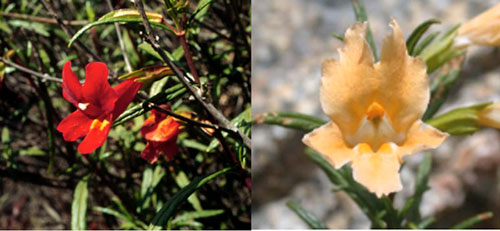
Fig. 2. Color morphs of Mimulus aurantiacus.
Select Publications
- Kono, Y; Kohn, JR. 2015. Range and Frequency of Africanized Honey Bees in California (USA). PLoS ONE v. 10(9): p. e0137407-0.
- Rightmyer, MG; Kono, Y; Kohn, JR; Hung, KL. 2014. A new species of Triepeolus (Hymenoptera: Apidae), with comments on T. utahensis (Cockerell) and T. melanarius Rightmyer. Zootaxa v. 3872(1): p. 48-56.
- Handelman, C, JR Kohn. 2014. Hummingbird color preference within a natural hybrid population of Mimulus aurantiacus (Phrymaceae). Plant Species Biology doi: 10.1111/j.1442-1984.2012.00393.x
- Biliniski, P, JR Kohn. 2012. Sites of self-pollen tube inhibition in Papaveraceae (sensu lato). Plant Systematics and Evolution 98: 1239-1247.
- Goldberg E, JR Kohn, R Lande, KA Robertson, SA Smith and B Igic. Species selection maintains self-incompatibility. Science 330: 493-495.
- Paape T and JR Kohn. 2011. Differential strengths of selection on S-RNases from Physalis and Solanum (Solanaceae). BMC Evolutionary Biology 11: 243 doi:10.1186/1471-2148-11-243
- Paape T, T Miyake T, N Takebayashi N, D Wolf D and JR Kohn JR. 2011. Evolutionary genetics of an S-Like polymorphism in Papaveraceae with putative function in self-incompatibility. PLoS ONE 6(8): e23635. doi:10.1371/journal.pone.0023635
- Newbigin. E, T Paape and JR Kohn. 2008. RNase-based self-incompatibility: puzzled by pollen-S. Plant Cell 20:2286-2292.
- Igic, B, R Lande and JR Kohn 2008. Loss of self-incompatibility and its evolutionary consequences. International Journal of Plant Sciences 169:93-104.
- Paape T., B Igic, SD Smith, R Olmstead, L Bohs and JR Kohn. 2008. A 15-My-old genetic bottleneck. Molecular Biology and Evolution 25:655-663.
- Streisfeld, MA, and JR Kohn. 2007. Environment and pollinator-mediated selection on parapatric floral races of Mimulus aurantiacus. Journal of Evolutionary Biology 20:122-132.
- Igic B, and JR Kohn. 2006. The distribution of plant mating systems: study bias against obligately outcrossing species. Evolution 60:1098-1103.
- Igic, B, L Bohs, and JR Kohn. 2006. Molecular fossils reveal unidirectional breeding system shifts. Proceedings of the National Academy of Sciences USA 103:1359-1363.
- Streisfeld, MA, and JR Kohn. 2005. Contrasting patterns of floral and molecular variation across a cline in Mimulus aurantiacus. Evolution 59:2548-2559.
- Yeung K., JS Miller, AE Savage, BC Husband, B Igic and JR Kohn. 2005 Association of ploidy and sexual system in Lycium californicum (Solanaceae). Evolution 59:2048-55.
- Biliniski, P, JR Kohn. 2012. Sites of self-pollen tube inhibition in Papaveraceae (sensu lato). Plant Systematics and Evolution 98: 1239-1247. Igic, B. and J. R. Kohn. 2001. Evolutionary relationships among self-incompatibility RNases. Proceedings of the National Academy of Sciences USA 98:13167-13171.
Biography
Joshua R. Kohn received his Ph.D. from the University of Pennsylvania and was a postdoctoral fellow at both the University of Toronto and Cornell University.