
Donald Helinski
Profile
Don Helinski joined UCSD in 1965 as Associate Professor of Biology. After spending three years as a postdoctoral fellow at Stanford University in the lab of Charles Yanofsky, a leading American geneticist whom he considers his mentor and major scientific influence, he joined Princeton University as an Assistant Professor in Biology. Back in January 1962, on his way to Princeton from Palo Alto, Don made a stop in San Diego to participate in a small scientific meeting organized by David Bonner. There he had an opportunity to interact with David Bonner who mentored his own mentor, Charles Yanofsky, at Yale. (Interestingly enough, years later, Charles Yanofsky’s son, Marty Yanofsky, an outstanding plant biologist in his own right, worked in Don Helinski’s lab as an undergraduate student.) David Bonner asked Don Helinski how long his commitment at Princeton was going to be and if he might be interested in joining faculty at UCSD at a later date. Don replied that he was definitely interested; however, he had to honor his three-year contract with Princeton. In about a year, Bonner contacted him again trying to lure Don to his fledgling Department of Biology at UCSD after his contract with Princeton was over. Don promised to seriously consider it. However, soon Bonner got very ill and had to leave UCSD to move to the Bay Area for treatment. In 1964, David Bonner died from Hodgkin’s disease…
Don didn’t hope to hear from UCSD again, but a year later he was contacted by Jon Singer, the new Department Chair and a close friend of David Bonner. Don came out to the campus to give his seminar and was immediately offered a tenured position of the Associate Professor, which he accepted. He was ready to come back to California which felt like home after his Stanford days and, besides, a number of prominent and interesting scientists in various areas of life sciences were joining UCSD at that time, which promised to create a unique research environment. Don’s wife Patricia, a native-borne Californian, was very happy to return to her home state.
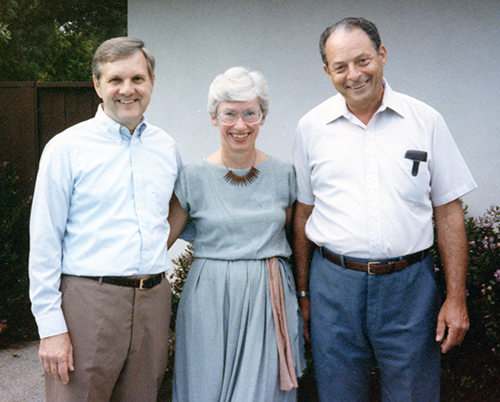
Don Helinski, Pat Helinski, and Charles Yanofsky
Don joined a small group of biologists who were brought to campus by David Bonner: Jon Singer, Jack DeMoss, Stanly Mills, Mel Green, and Warren Butler. Earlier, just before Don came to Princeton, he was awarded an NIH research grant that allowed him to pursue his interest in microbial genetics and focus mainly on studying plasmids, small circular DNA units capable of replicating independently. At that time, resistance to antibiotics was already a growing problem, and the rationale for his research was that plasmids might hold the key to understanding the mechanism of resistance and the ways to overcome it. As it became customary since early 1960s, his basic research was supported by NIH in the hopes of finding practical applications in dealing with bacterial antibiotic resistance.
Don was assigned an office and laboratory on the fourth floor of Bonner Hall where he continued his research. One of his neighbors was the famous chemist Stanley L. Miller, who was conducting research on the origin of life by experimenting with the ‘primordial soup’ to generate amino acids from inorganic substances with the help of electrical discharges. Don recalls it was truly fascinating to be working next to him. Jack DeMoss and Stanley Mills had their labs nearby. Jack DeMoss was a biochemist and early on was viewed as a leading figure in the Department of Biology. He was well-respected and had a key role in hiring decisions. Don remembers that he was very approachable and supportive of his younger colleagues -- after a few years he left for the University of Texas at Houston. Prominent biochemists Martin Kamen who discovered Carbon-14 and Bruno Zimm, brilliant in his early DNA discoveries, were also Bonner Hall neighbors. It was David Bonner’s concept to mix biologists, chemists, and biochemists in the same building to create the environment of scientific ‘cross-pollination’ and open flow of ideas. He was a big believer in the importance of interactions between scientists in different disciplines that might foster interdisciplinary research. David Bonner’s influence was still felt in the way faculty interacted, shared ideas and enjoyed collegial and very honest discussions. Don recalls that, in those days, faculty always made efforts to present their work to colleagues. Everybody was aware of what kind of work their colleagues were doing and shared critical feedback with one another. The atmosphere was very congenial -- no pecking order – and very cooperative. Everybody worked hard and was committed to David Bonner’s vision.
Within the next couple of years, Don had three graduate students working in his lab and his research on plasmids was progressing extremely well. His lab was the first to publish electron microscopy pictures that proved that a plasmid was indeed a ring of DNA and also established the techniques to readily isolate those plasmids. This groundbreaking research was the important precursor of the Boyer-Cohen experiment on recombinant DNA technology that opened up the era of genetic engineering and the explosive growth of biotechnology.
Don was very involved with the early stages of recombinant DNA research which started as a very controversial field. He was among a group of scientists appointed by NIH to set the guidelines for conducting this type of research. Don was a strong proponent of recombinant DNA research and participated in public debates to prove its benefits and safety. He recalls one such debate in Mandeville Center on campus when 750 people showed up to hear his debate with the famous Caltech biologist and later Chancellor of the UC Santa Cruz Robert Sinsheimer. Don’s approach was strongly supported by Roger Revelle, who believed that the potential benefits of this type of research far outweighed the remote possibility of any danger. Don remains an unwavering defender of the so called GMOs and is simply irritated by some grocery stores that display ads like “We do not sell products with GMOs”. He points out that, today, virtually all soybean and corn plants, as well as most rice varieties are genetically modified, reducing the use of herbicides and pesticides and greatly improving the growth of crops that are especially vital in the developing countries. It is evident that Don is very passionate about educating the general public about scientific discoveries and being more outspoken on issues that raise concerns.
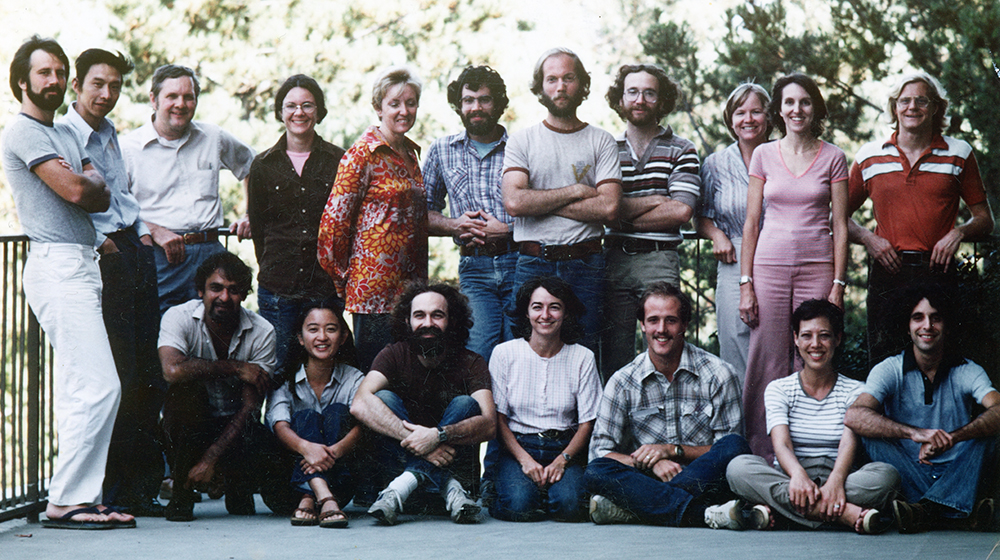
Helinski Lab circa 1979 including Don Helinski (third from left), Jeff de Wet (top row, sixth from left) and Marty Yanofsky (bottom row, first from right)
Around 1983, a colleague, Marlene DeLuca -- a biochemist studying bioluminescence in fireflies and the wife of Chancellor Bill McElroy -- suggested in a casual conversation to collaborate on isolating the gene from firefly, putting it into a plasmid and turning bacteria into an inexpensive and efficient ‘manufacturer’ of the enzyme called luciferase. The study of luciferase was the main research interest of Bill McElroy when he was a professor at John Hopkins University and Marlene DeLuca, who at that time was his graduate student, continued this research. Getting the enzyme was a very laborious procedure – collecting fireflies, crushing them and then purifying the enzyme. Actually, back in the day, it was told that Bill McElroy would pay children a penny a piece for collecting fireflies for him. So isolating a gene from a firefly, splicing it into a plasmid and then mass-producing luciferase seemed like a fast and straight-forward alternative.
The idea appealed to Don and he started joint research with Marlene DeLuca primarily to help a colleague, but also to put his concept to a practical use. Experiments conducted by their graduate students Jeff de Wet and Keith Wood yielded spectacular results. Cloned luciferase was subsequently patented by the University of California and proved invaluable in a multitude of uses in basic research, medical and pharmaceutical research, and bioengineering. Today, there are over 20,000 research publications where luciferase is used as a ‘reporter gene’ in the analysis of gene expression in studying developmental processes, hereditary diseases, and pharmacological efficacy. Don is deeply pleased that luciferase proved to be an important contribution to science, as well as a source of tens of millions dollars of revenue for the university. However, for him it was still sort of a ‘side project’ -- his work on plasmids was his main focus and he continued his research till 2006 when he closed his lab after working on the same NIH grant for 44 years. He is a member of the National Academy of Sciences since 1980.
Don remembers that he always liked science – ever since his parents, neither of whom had education beyond high school, bought him a chemistry set for kids when he was 8 or 9 years old. He set up his lab in the family home’s basement, next to the piles of wood and coal, and spent most of his free time there. It was the first of several, more sophisticated kits that followed and his mind was made up – he was going into medical science. But after the first year at Case Western University School of Medicine, which at that time was one of the few institutions that had a combined degree program – Ph.D. and M.D.—Don realized that a medical degree took too long. He decided to work towards his Ph.D. degree instead and never regretted it since. He credits most of his success to constant self-study and ability to stay focused. Looking back, Don Helinski feels that he has been very fortunate to have a successful and rewarding scientific career that gave him so much joy.
Biography
Don Helinski earned his Ph.D at Case Western University and held a postdoctoral fellowship at Stanford University. Before joining the faculty at UCSD, he was on the faculty at Princeton University. He is a member of the National Academy of Sciences and the American Academy of Arts and Sciences. He is also a Fellow of the American Association for the Advancement of Science and an elected member of the European Molecular Biology Organization and the American Academy of Microbiology.